
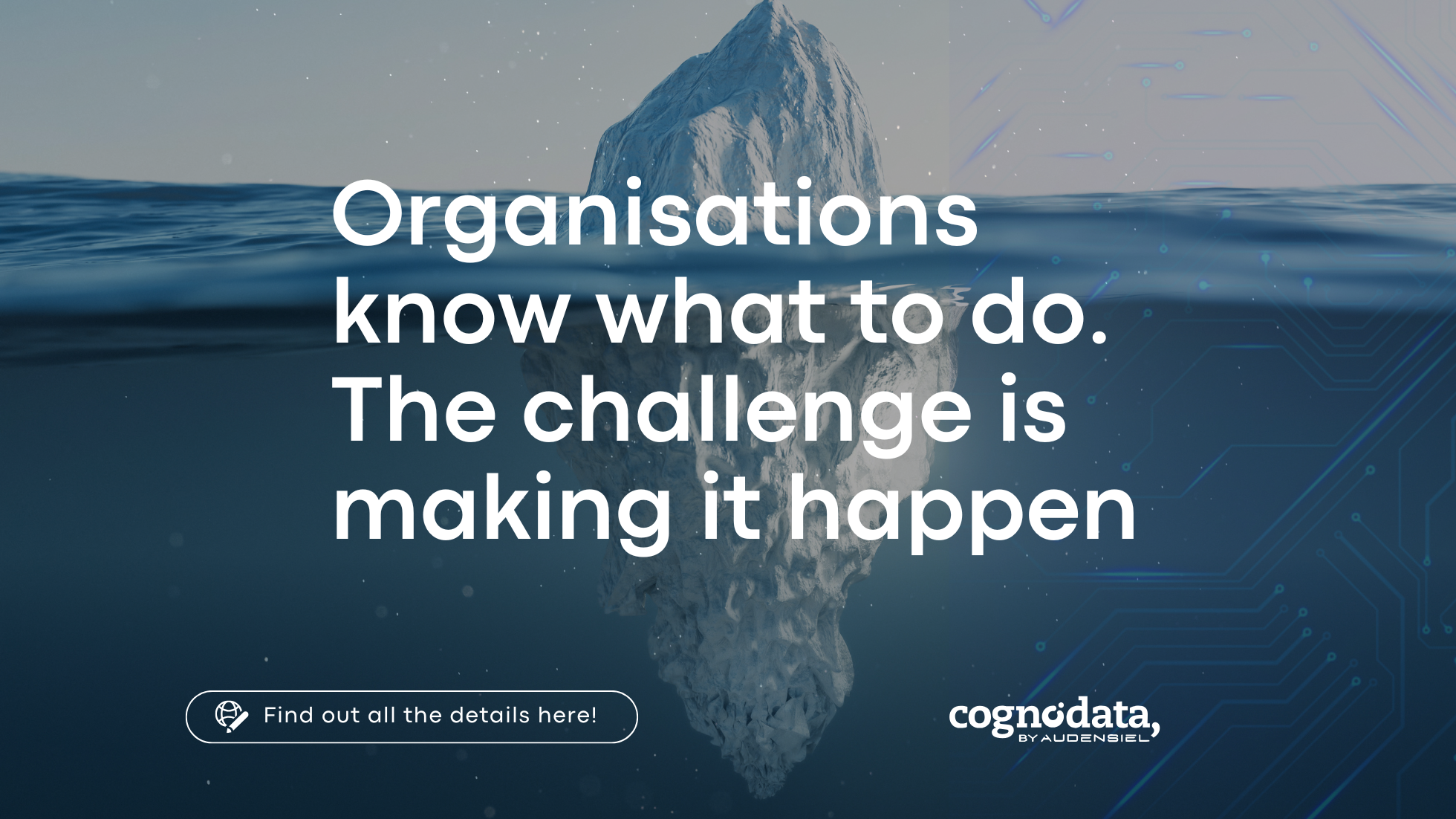
This is the core challenge of AI adoption in organisations. Most executives involved in data and AI projects do not lack knowledge. They know what needs to change. They have read the reports, approved the strategy and reviewed case studies from other organisations.
And yet, change does not happen.
MIT Sloan Management Review reports that 95% of AI pilots fail to deliver measurable results. Gartner estimates that 60% of AI initiatives will not meet their objectives by 2027. These are not technical failures. They are organisational failures. And they have an explanation that rarely appears in progress reports.
The system is designed not to change
Not out of bad intent, but because organisations are systems that have survived by optimising what already works. Shifting towards data- and AI-driven models is not an incremental improvement; it is a redistribution of power, control and professional identity.
The power no one wants to lose
Harvard Business School identifies one of the most subtle mechanisms of organisational resistance: middle managers and executives defend their authority through team size and budget control. When AI automates decisions that once relied on their judgement, they do not just lose tasks. They lose status.
“Automation does not just change processes. It changes who has a voice in the room.”
The outcome is predictable. No one openly rejects the project. But validations multiply, timelines stretch and urgency disappears. Resistance is not formal opposition. It is a silent erosion that no tracking system captures.
In banking, insurance and retail, the pattern is always the same. Technically sound projects become trapped in conflicts between business units over who controls the models, who owns the data and who is accountable for outcomes.
Incentives that block change
MIT CISR highlights something every executive recognises: organisational inertia is not irrational. It is locally rational.
Most incentive systems still measure volume, process compliance and short-term results. They do not measure the adoption of new ways of working or structural transformation. In this context, the rational behaviour of an overloaded middle manager is to close the month, not redesign how their team operates.
“When the cost of change falls on the individual and the benefit ends up in a boardroom presentation, the rational choice is not to change.”
This explains why so many organisations have transformation strategies that look flawless on paper but deliver mediocre results in practice. It is not a problem of understanding. It is a problem of alignment between what is stated and what is rewarded.
The emotional dimension of change
Research linked to Harvard on resistance to change points to a central cause of the gap between knowing and doing: emotion. Not in the sense of irrationality, but in a more precise way—fear of losing control, exposure or relevance.
AI and data challenge professional identities built over years.
“I have judgement. I do not need a model to tell me what to do.”
This mindset, whether expressed or not, underlies many of the blockers that are labelled in reports as “lack of digital maturity” or “resistance to change”. Without spaces to process this tension, organisations respond with cynicism, passive resistance and minimal compliance: agreement in meetings, inaction in practice.
What distinguishes organisations that move forward
They do not have less resistance. They have better mechanisms to manage it.
Gartner identifies three conditions that differentiate organisations that successfully scale data and AI initiatives from those stuck in endless pilots: clear data ownership with explicit accountability, incentives redesigned to reward adoption—not just outcomes—and executive sponsorship that protects projects politically when resistance emerges.
The third condition is the most critical and the least common. Without someone with real authority willing to name the blockage and absorb the political cost of addressing it, even the most technically robust project ends up shelved.
“Transformation is not held back by technology. It is held back by the lack of willingness within the organisation to bear the cost of executing it.”
The question that determines success
Before approving the next data or AI initiative, there is one question few organisations ask with sufficient honesty:
Have we identified who will block this project, why they will do so, and who has the authority to address it?
If the answer is unclear, the problem is not the model. It is the conversation no one has been willing to have.
AI adoption in organisations FAQs
Why do organisations fail to implement AI despite knowing what to do?
Because of organisational barriers such as resistance to change, misaligned incentives and the redistribution of power.
What is the main reason AI projects fail?
It is not technical. It is organisational: lack of alignment, governance and the ability to manage internal resistance.
What do organisations need to scale AI successfully?
Clear data ownership, aligned incentives and strong executive leadership capable of managing organisational resistance.
